
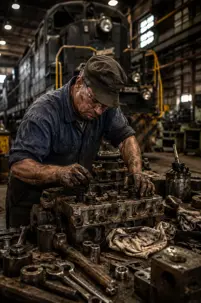
The Hidden Hazard in the Engine House: How Locomotive Maintenance Exposed Machinists to Asbestos Dust
For much of the twentieth century, railroad engine houses across the Midwest—particularly in states like Indiana, Illinois, and Ohio—were the beating heart of locomotive maintenance. Inside these cavernous shops, machinists, laborers, and other skilled trades kept diesel-electric locomotives in service through constant inspection, repair, and overhaul.
What few of these workers were told, however, was that the very equipment they maintained—pumps, valves, compressors, brakes, engines, and electrical systems—was built with materials that, when disturbed, could release dangerous asbestos dust into the air.
A Rolling Industrial System—Maintained by Hand
Locomotives manufactured from the 1950s through the 1970s were not sealed, self-contained systems. They required continuous hands-on maintenance, often performed in close quarters and under time pressure.
Machinists routinely worked on:
- Diesel engines and their exhaust systems
- Generators and traction motors
- Air compressors and brake systems
- Pumps, valves, and piping networks
- Auxiliary heaters and steam generators
Each of these systems relied on gaskets, packing, insulation, and friction materials—many of which historically contained asbestos because of its resistance to heat, friction, and chemical breakdown.
Routine Tasks That Generated Dust
The exposure risk did not arise from unusual events—it was embedded in ordinary, repetitive maintenance work.
Gasket Removal and Replacement
Engine overhauls required machinists to disassemble components sealed with compressed gaskets. Removing these often meant:
- Scraping flange surfaces with hand tools
- Wire brushing residual material
- Cutting replacement gasket sheets to fit
These activities could release visible dust from deteriorated gasket material, particularly when older, heat-brittled components were disturbed.
Valve and Pump Packing Work
Pumps and valves throughout the locomotive required periodic repacking to maintain pressure integrity. This involved:
- Pulling out worn packing from stuffing boxes
- Cutting and installing new packing rings
Packing materials frequently contained braided asbestos fibers, which could fray and become airborne during removal and installation.
Brake Maintenance
Brake work—on both locomotives and railcars—was one of the most significant sources of exposure. Tasks included:
- Removing and installing brake shoes
- Grinding or sanding brake surfaces for fit
- Cleaning accumulated brake dust
Brake linings of the era commonly used asbestos-based friction materials, and disturbance during maintenance could release fine particulate dust into the surrounding air.
Insulation Disturbance
Engine houses were filled with insulated components:
- Exhaust systems
- Steam lines
- Air and fluid piping
- Heaters and steam generators
Machinists and adjacent trades often worked around or directly handled these materials, which could:
- Crack and crumble with age
- Shed fibers when cut, removed, or even brushed against
Compressor and Auxiliary Equipment Overhauls
Air compressors and auxiliary systems required disassembly and resealing. This work involved:
- Removing bolted housings
- Replacing internal gaskets and seals
- Cleaning component surfaces
Each step had the potential to disturb asbestos-containing materials embedded within the equipment.
The Environment: Enclosed, Busy, and Dust-Laden
Engine shops amplified these exposures. Work was typically performed:
- Indoors, with limited ventilation
- Alongside other trades performing similar dusty tasks
- On multiple locomotives simultaneously
Dust generated in one area could linger or migrate, contributing to both direct and bystander exposure.
A Common Industrial Practice, Not an Isolated Risk
The use of asbestos in these components was not accidental or rare—it was standard across the industry. Locomotive manufacturers and their suppliers relied on asbestos-containing materials for:
- Heat insulation
- Sealing under pressure
- Friction control in braking systems
- Electrical insulation in high-energy environments
As a result, machinists maintaining locomotives in Midwest engine houses were often exposed not just once, but repeatedly over the course of their careers.
Looking Back
Today, the risks associated with asbestos exposure are well understood. But for the machinists who spent years maintaining locomotive engines and their many integrated components, exposure often occurred without warning, protection, or recognition.
Their work kept the nation’s rail system moving—quietly sustaining the industrial economy—while the hazards embedded in the equipment they serviced remained largely invisible.
Our firm is committed to standing with the machinists who kept the Midwest’s industrial corridor running—men whose skill, grit, and daily labor ensured that commerce moved, factories stayed supplied, and communities prospered. They paid the price for that progress not in the moment, but years later, through cancer tied to the very equipment they were tasked with maintaining. We pursue justice on their behalf with the same persistence they brought to their work, holding accountable those responsible and seeking to secure the dignity, recognition, and compensation these workers and their families deserve.
Endnotes: Representative Equipment and Product Brands
- Locomotive manufacturers supplying diesel-electric units in the Midwest included Electro-Motive Division (EMD), General Electric (GE), and American Locomotive Company (ALCO).
- Gaskets and packing materials used in engines, pumps, and valves were commonly supplied by Garlock Sealing Technologies, Johns-Manville, Flexitallic, and A.W. Chesterton Company.
- Brake shoes and friction components were manufactured by companies such as Abex Corporation, Bendix Corporation, and Raybestos-Manhattan.
- Insulation materials applied to piping, exhaust systems, and auxiliary equipment included products from Owens-Illinois, Pittsburgh Corning, Eagle-Picher, and Armstrong World Industries.
- Compressors and pneumatic equipment used in locomotive systems were produced by Ingersoll-Rand, and braking systems by Westinghouse Air Brake Company (WABCO).
- Electrical components and systems incorporating heat-resistant insulation were supplied by Westinghouse Electric Corporation and General Electric (GE).
- Steam generators and heating units used on certain locomotives were manufactured by Vapor Corporation and Elesco.