
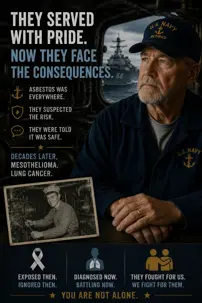
Unseen Exposure, Unspoken Consequences: Why Many Naval Veterans Never Connect Asbestos to Their Cancer Diagnosis
For generations, service aboard U.S. naval vessels came with an unspoken reality: constant exposure to asbestos. From engine rooms to sleeping quarters, asbestos-containing materials were embedded throughout ships as a matter of standard design. Yet today, many naval veteran retirees diagnosed with serious illnesses like mesothelioma and lung cancer remain unaware that their condition may be directly tied to those exposures—particularly during high-risk periods when ships entered dry dock for repair and overhaul.
A Shipboard Environment Saturated with Asbestos
Throughout much of the 20th century, asbestos was prized by the Navy for its fire-resistant and insulating properties. It was used extensively in pipe insulation, boilers, turbines, pumps, valves, gaskets, and bulkhead materials. Sailors working in engineering spaces, as well as those assigned to maintenance duties, were often surrounded by these materials daily.
The danger intensified during shipyard overhauls. When vessels were brought into dry dock at facilities like Norfolk Naval Shipyard or Portsmouth Naval Shipyard, large-scale repairs required cutting, stripping, and replacing asbestos-containing components. These activities released significant amounts of airborne fibers into confined spaces—often without adequate respiratory protection or meaningful warnings to those working nearby.
The Latency Problem: Illness Decades in the Making
One of the most significant barriers to awareness is time. Diseases like mesothelioma can take 20 to 50 years to develop after exposure. By the time symptoms appear, many veterans have long since retired, and the connection between their naval service and their illness is far from obvious.
Without a clear triggering event or immediate injury, veterans may attribute their diagnosis to aging, lifestyle factors, or chance—never realizing that the seeds of disease were planted decades earlier in a ship’s engine room or during a dry dock overhaul.
A History of Incomplete Warnings
Compounding the issue is the historical lack of transparency regarding asbestos risks. While the dangers of asbestos were increasingly recognized in medical and industrial circles throughout the mid-20th century, that knowledge did not consistently translate into warnings or protections for enlisted personnel.
Many veterans report never being informed of the risks, never being provided adequate protective equipment, and never being trained on how to avoid exposure—even when working directly with asbestos-containing materials.
Institutional Complexity and Limited Awareness of Benefits
Even today, awareness of available remedies remains uneven. The U.S. Department of Veterans Affairs does recognize certain asbestos-related conditions as service-connected, which can entitle veterans to disability compensation and medical care. However, because active-duty military service limits the ability to bring direct legal claims against the government, many veterans are unaware that other avenues—such as claims against manufacturers of asbestos-containing products—may still be available.
Cultural Factors: A Generation That Didn’t Question Risk
There is also a cultural dimension that cannot be ignored. Many naval veterans served in an era when hazardous conditions were accepted as part of the job. Questioning safety practices was not always encouraged, and long-term health consequences were rarely discussed. This mindset persists into retirement. Veterans may downplay their exposures or fail to connect them to their illness, particularly in the absence of clear guidance from authoritative sources.
Bridging the Awareness Gap
The reality is that a substantial number of naval veteran retirees remain unaware of the causal link between their service and their diagnosis. This lack of awareness can delay or entirely prevent them from seeking benefits, medical support, or legal recourse.
Closing this gap requires more than medical diagnosis—it requires education, investigation, and advocacy. Veterans deserve to understand not only what they were exposed to, but how those exposures may have shaped their health decades later.
Conclusion
For too many naval veterans, the connection between asbestos exposure—especially during high-risk dry dock repairs—and life-altering diagnoses like mesothelioma and lung cancer remains obscured by time, silence, and complexity. Bringing that connection into focus is essential to ensuring they receive the recognition, care, and accountability they have long been owed.
Our firm is dedicated to educating naval retirees about the critical link between their asbestos exposure and resulting illnesses, ensuring they understand their rights, and relentlessly pursuing justice on behalf of them and their families.