
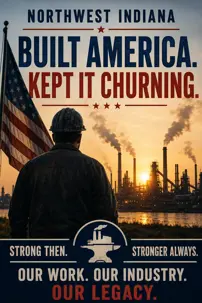
Backbone of American Industry: The Enduring Cost of Industrial Production on Northwestern Indiana’s Workforce
For much of the 20th century, Northwestern Indiana—particularly the Calumet Region encompassing Gary, East Chicago, Hammond, and Whiting—stood as one of the most heavily industrialized corridors in the United States. Steel mills, oil refineries, chemical plants, and power-generating facilities powered the nation’s economy and provided stable, lifelong employment for generations of workers. Yet embedded within that industrial success was a pervasive and largely unrecognized hazard: widespread asbestos exposure.
From the 1940s through the late 1970s, asbestos was considered indispensable across nearly every major industrial operation in the region. Its heat-resistant and insulating properties made it ideal for use in blast furnaces, coke ovens, steam lines, boilers, turbines, and refinery processing units. At massive facilities like U.S. Steel’s Gary Works and Inland Steel in East Chicago, asbestos was not confined to isolated components—it was integrated into the very infrastructure of the plants.
Workers encountered asbestos daily, often without any warning or protective equipment. Pipefitters cut through asbestos insulation. Maintenance crews stripped and replaced deteriorating lagging. Furnace operators worked alongside equipment lined with asbestos-containing refractory materials. Even those who never handled asbestos directly—laborers, supervisors, and electricians—were exposed to airborne fibers that circulated throughout these enormous facilities.
The risk was not limited to a single jobsite. Many careers in Northwestern Indiana were defined by movement between facilities—steel mills, refineries, and industrial plants—each contributing to cumulative exposure. A worker might spend years at a steel mill before transitioning to a refinery or power plant, unknowingly increasing their lifetime asbestos burden with each position.
Refineries in the region, including those in East Chicago and Whiting, presented their own distinct hazards. Asbestos was widely used in pipe insulation, gaskets, valve packing, and boilers. During maintenance shutdowns—known as “turnarounds”—workers removed and replaced aging asbestos materials in confined spaces, creating dense concentrations of airborne fibers.
Compounding this occupational exposure was the phenomenon of “take-home” exposure. Workers often returned home covered in dust, unknowingly bringing asbestos fibers into their households. Spouses and children were exposed while laundering clothing or simply sharing living spaces, extending the reach of industrial exposure far beyond the plant gates.
Decades later, the consequences of these exposures continue to emerge. Mesothelioma—a rare and aggressive cancer caused almost exclusively by asbestos—and asbestos-related lung cancer are now being diagnosed in retirees who last set foot in these facilities 30, 40, or even 50 years ago. This delay is not unusual; asbestos-related diseases are defined by a long latency period, often spanning two to five decades between exposure and diagnosis.
Today, many retirees from Northwestern Indiana’s industrial workforce face diagnoses that can be traced not to a single incident, but to years of repeated, overlapping exposure across multiple job sites. Their work histories tell a consistent story: asbestos was everywhere—woven into the equipment, the environment, and the daily routines of industrial life.
Understanding this cumulative exposure is critical. It underscores not only the medical reality of mesothelioma and lung cancer but also the broader context in which these diseases developed. For the men and women who spent their careers building and sustaining America’s industrial backbone, the risks were not isolated—they were systemic, continuous, and, for far too long, unacknowledged.
Our firm remains steadfastly committed to securing justice for Northwestern Indiana’s retired blue-collar workforce—the very backbone of this country’s industrial strength—and to standing with their families to ensure their years of sacrifice are met with accountability, dignity, and the full measure of compensation they deserve.