
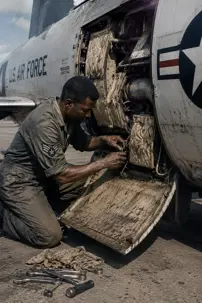
Sophisticated Engineering, Primitive Protection: The Asbestos Legacy in Aircraft Maintenance
For generations, military and civilian aircraft mechanics stood as the unseen backbone of aviation—ensuring that planes remained safe, operational, and mission-ready. Whether servicing fighter jets on a military base or maintaining commercial airliners in bustling hangars, these skilled workers took pride in precision and reliability. Yet, hidden within the very aircraft they repaired was a danger few could see and even fewer understood: asbestos.
A Ubiquitous Material in Aviation
Throughout much of the 20th century, asbestos was widely used in aircraft manufacturing. Its appeal was obvious—heat resistance, durability, and insulating properties made it ideal for high-performance machinery operating under extreme conditions. As a result, asbestos found its way into countless aircraft components, including brake systems, engine insulation, gaskets, valves, and cockpit heating systems.
From the 1930s through the early 1980s, both military and commercial aircraft were built with these materials. Mechanics working during this era routinely handled, repaired, and replaced asbestos-containing parts—often without protective equipment or awareness of the risks.
Daily Work, Invisible Risk
The danger was not merely in the presence of asbestos, but in the work itself. Routine maintenance—grinding down brake pads, cutting into insulation, replacing worn gaskets—released microscopic asbestos fibers into the air. These fibers could linger in enclosed spaces like cockpits and engine compartments, where mechanics spent long hours performing detailed repairs.
Inhaling or ingesting these fibers was often unavoidable. Even protective equipment of the time, such as heat-resistant gloves or blankets, frequently contained asbestos themselves, compounding the exposure.
For many mechanics, especially those in military service during periods like World War II and the Cold War, exposure was not occasional—it was constant. Aircraft across all categories, from bombers to helicopters, incorporated asbestos in critical systems, making contact with the material an almost daily occurrence.
The Long Latency of Disease
One of the most devastating aspects of asbestos exposure is its delayed impact. Diseases such as mesothelioma and asbestos-related lung cancer can take decades—often 20 to 50 years—to manifest.
By the time symptoms appear, many retirees have long since left the workforce, unaware that their years of service carried a hidden cost. What once felt like routine maintenance work becomes, in retrospect, the source of a life-altering diagnosis.
Studies and occupational data consistently show that aircraft mechanics face an elevated risk of developing these diseases due to repeated exposure to asbestos-containing materials.
Veterans and Civilian Workers Alike
This crisis does not distinguish between military and civilian service. U.S. Air Force mechanics, Navy aviation technicians, and private-sector maintenance crews all shared similar working conditions and exposures. Military environments often intensified the risk, with asbestos present not only in aircraft but also in hangars, carriers, and support equipment.
For veterans, the consequences are particularly profound. Many served in roles critical to national defense, only to face serious health conditions years after their service ended. Civilian mechanics, too, contributed to the rapid expansion of commercial aviation—keeping fleets airborne while unknowingly exposing themselves to toxic fibers.
A Legacy That Still Lingers
Although asbestos use has been heavily restricted since the 1980s, the danger has not been entirely eliminated. Older aircraft still in operation, legacy components, and imported parts can continue to pose exposure risks for modern mechanics.
For retirees, however, the issue is no longer about prevention—it is about recognition. The illnesses now surfacing are not random; they are the predictable result of occupational exposure that occurred decades ago.
Relief Available
What happened to aircraft mechanics reflects a stark imbalance between sophisticated engineering and a primitive disregard for worker protection. When that neglect results in mesothelioma, lung cancer, and other asbestos-related diseases decades later, accountability is not optional—it is overdue. Our firm is committed to pursuing justice for these skilled military and civilian workers whose labor kept aviation moving and whose exposure should never have been the price of that service.