
From Defense Insight to Investigative Asset: How Illinois Boiler and Pressure Vessel Records Help Reconstruct Forgotten Asbestos Exposure
A central difficulty in asbestos litigation is the passage of time. Mesothelioma claims often arise decades after the alleged exposure, long after industrial facilities have closed, equipment has been replaced, and firsthand institutional memory has faded. Plaintiffs are frequently asked to identify specific manufacturers of boilers and pressure vessels they encountered in the 1960s through the 1980s—an expectation that is often unrealistic given how industrial environments operated and how information was recorded at the time.
Many workers recall performing maintenance in boiler rooms, powerhouses, factories, or railroad facilities, but they did not interact with equipment through manufacturer branding. Boilers and pressure vessels were typically identified by location or function rather than by nameplate details. As a result, even credible testimony may lack precise product identification decades after exposure occurred.
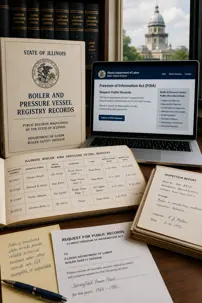
In that context, Illinois boiler and pressure vessel inspection and registration records provide an especially important evidentiary resource. Unlike private corporate records or documents controlled by premises owners or manufacturers, these records were maintained as part of a public regulatory system by the State of Illinois. They were created for safety oversight and inspection purposes, not litigation, and were preserved as part of governmental compliance infrastructure.
That distinction matters. In asbestos litigation, counsel often encounters significant obstacles when seeking historical records from private entities that may no longer exist or that have clear incentives to resist producing documentation that could establish product presence or liability exposure. By contrast, publicly maintained state records are generally more stable, neutral in origin, and less susceptible to the gaps, loss, or selective preservation that can affect private corporate archives over time.
These inspection and registration documents may include manufacturer names, serial numbers, installation dates, inspection histories, and facility-specific equipment details. When available, they can help reconstruct what boilers and pressure vessels were installed at a given site during the relevant time period—even where the physical facility has since been demolished or substantially altered.
This is particularly significant in asbestos cases because industrial boilers and pressure vessels frequently incorporated asbestos-containing materials, including insulation, refractory products, gaskets, and thermal coverings. Identifying the equipment installed at a worksite can therefore help establish potential sources of exposure and provide an objective foundation for reconstructing historical conditions.
Illinois industrial facilities commonly utilized boilers manufactured by companies such as Babcock & Wilcox, Cleaver-Brooks, Combustion Engineering, and others whose systems were widely deployed across industrial, institutional, and commercial settings. These systems often remained in service for decades, during which time maintenance and repair activities could disturb asbestos-containing components.
In litigation, the value of these records is not to replace witness testimony, but to support and corroborate it. When a former worker recalls exposure in a boiler room but cannot identify a manufacturer, state-maintained inspection data may confirm which equipment was present during their employment period. This can strengthen exposure reconstruction and reduce reliance on memory alone for details that were never expected to be preserved.
Their importance is especially pronounced in cases involving demolished facilities or entities that no longer exist. In those circumstances, publicly maintained regulatory records may represent one of the few remaining objective sources of information about historical industrial equipment.
Attorneys familiar with industrial equipment identification issues—particularly those who have previously analyzed or challenged product identification evidence—are often well positioned to utilize these records effectively. That experience can be redirected toward reconstructing exposure histories when traditional discovery avenues are no longer viable or have become incomplete with the passage of time.
Ultimately, Illinois pressure vessel and boiler inspection records serve as a critical tool for restoring clarity to industrial histories that might otherwise be lost. By relying on publicly maintained state documentation rather than exclusively on private records subject to availability or incentive-driven disclosure limitations, counsel can more reliably reconstruct the conditions that contributed to asbestos exposure decades ago.
Relief is Available
Our firm’s prior experience working with industrial equipment identification and record analysis now serves a renewed purpose in helping identify responsible defendants on behalf of injured clients. That background allows us to use publicly maintained state records effectively to reconstruct historical exposure scenarios and pursue accountability even when private documentation has been lost, withheld, or diminished by the passage of time.