
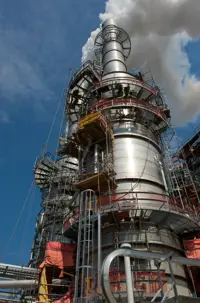
Built to Withstand Heat, Not Time: Wood River’s Industrial Rise and the Hidden Legacy of Asbestos
Along the banks of the Mississippi River, Wood River grew into a powerful engine of industrial productivity. For decades, its skyline reflected the strength of American industry—refining operations, power generation, and heavy mechanical work all converging to support a blue-collar workforce that kept essential systems running. But beneath that legacy lies a more sobering reality: the widespread use of asbestos across these industries quietly exposed generations of workers to a dangerous and ultimately deadly hazard.
Throughout much of the twentieth century, asbestos was considered indispensable in industrial environments. Its resistance to heat, fire, and chemical degradation made it a standard component in insulation, piping systems, turbines, and countless other applications. In facilities throughout Wood River, asbestos was not an occasional presence—it was embedded in the infrastructure itself.
Workers encountered it daily. Insulators handled raw asbestos materials while applying or removing thermal coverings. Pipefitters and mechanics cut into aging systems wrapped in asbestos insulation. Maintenance crews performed repairs during shutdowns, often disturbing decades-old materials that had become brittle and prone to releasing microscopic fibers into the air. These tasks were rarely viewed as dangerous at the time, and meaningful protective measures were often absent.
The nature of industrial work in Wood River meant that exposure was rarely isolated. A single worker might spend years in one facility before moving to another nearby operation, carrying with them a cumulative history of contact with asbestos-containing materials. Over time, these repeated exposures compounded—often without any immediate symptoms or warnings.
What makes asbestos-related disease particularly insidious is its latency. Conditions such as Mesothelioma and asbestos-related Lung Cancer can take decades to develop, frequently emerging 20 to 50 years after initial exposure. As a result, many former workers from Wood River’s industrial peak are only now receiving diagnoses tied directly to the environments in which they built their careers.
The pattern that has emerged is difficult to ignore. Retirees who spent their working lives in physically demanding, essential roles—maintaining equipment, supporting production, and ensuring operational continuity—are now confronting life-altering illnesses rooted in those same workplaces. In many cases, they were never fully informed of the risks they faced, nor provided with the protections that might have reduced them.
Wood River’s story reflects a broader truth about America’s industrial past: progress was often achieved without a full understanding—or acknowledgment—of the long-term human cost. The materials that made industry more efficient and more durable also introduced risks that would not be fully realized until decades later.
Today, the legacy of asbestos exposure in Wood River is measured not only in its industrial achievements, but in the lives of the workers who powered them. Their experiences serve as a reminder that the true cost of industrial progress extends far beyond production—and that its consequences can endure long after the work itself is done.
Our firm is resolute in its mission to confront this legacy head-on—uncovering the truth, holding responsible parties accountable, and pursuing the full measure of justice owed to the Wood River retirees whose years of honest work came at an unforgiving cost.