
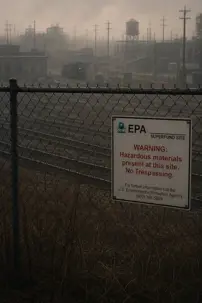
Toxic Tracks: The Hidden Legacy of the Elkhart Rail Yard
For generations, the Elkhart Rail Yard stood as one of the most important railroad facilities in the Midwest. Thousands of railroaders spent their careers there, helping move freight across the country and keeping America's rail network operating around the clock. Machinists, electricians, laborers, carmen, pipefitters, locomotive mechanics, conductors, and countless other skilled workers took pride in their work and in the role the facility played in the nation's economy.
What many did not know was that their daily work often involved exposure to hazardous substances that would not reveal their consequences until years—or even decades—later.
The Trades That Kept Elkhart Moving
The Elkhart Rail Yard was a sprawling operation where numerous crafts worked side-by-side maintaining locomotives, repairing railcars, fueling equipment, and coordinating freight movement.
Locomotive machinists and mechanics routinely handled powerful industrial solvents used to clean engines, traction motors, bearings, and mechanical components. Many of these degreasing products contained chemicals now associated with cancers affecting the kidneys, liver, and blood-forming system.
Electricians and maintenance personnel frequently worked in repair shops where industrial cleaners, fuel residues, and solvent vapors were common. Years spent working around these substances often resulted in repeated exposures that were viewed as simply part of the job.
Laborers and shop workers encountered hazardous materials while cleaning facilities, handling waste, assisting repair crews, and working throughout areas where chemicals were stored, used, or discarded. Unlike a single incident, these exposures accumulated over an entire career.
Diesel Exhaust: A Constant Presence
Few railroad workers at Elkhart escaped exposure to diesel exhaust.
Conductors, brakemen, machinists, laborers, hostlers, car inspectors, and shop personnel spent years around idling locomotives, switching operations, fueling areas, and maintenance facilities. Diesel-powered equipment operated day and night, producing exhaust that lingered throughout rail yards and repair shops.
Today, diesel exhaust is recognized as a human carcinogen and has been linked to an increased risk of lung cancer and other respiratory illnesses. For many railroad workers, exposure was not occasional—it was a daily reality for decades.
Asbestos Throughout Railroad Operations
In addition to chemical solvents and diesel emissions, asbestos was widely used throughout railroad equipment and facilities.
Workers encountered asbestos in locomotive insulation, gaskets, packing materials, brakes, electrical components, piping systems, and maintenance buildings. Machinists, pipefitters, electricians, laborers, and carmen often worked directly with or around these materials during repairs and maintenance.
Decades later, some of these same workers have been diagnosed with mesothelioma, lung cancer, and other asbestos-related diseases linked to exposures that occurred long before symptoms appeared.
More Than a Rail Yard: A Federal Superfund Site
The Elkhart Rail Yard's history extends beyond railroad operations. Portions of the property were ultimately designated a federal Superfund site after environmental investigations identified significant contamination from industrial solvents and other hazardous substances that had migrated into soil and groundwater.
That designation was not based on routine industrial activity alone. Rather, it reflected concerns that years of chemical use and disposal practices had created environmental contamination requiring federal oversight. As a result, responsible parties became subject to obligations that included environmental investigation, remediation efforts, long-term monitoring, and measures designed to reduce future risks to workers, nearby residents, and the surrounding community.
For many retired railroad workers, however, the designation carried an additional significance. It served as a reminder that the chemicals present throughout the facility during their careers were not merely workplace nuisances, but substances serious enough to warrant one of the nation's most significant environmental cleanup programs.
A Legacy Still Felt Today
The story of the Elkhart Rail Yard is not simply one of environmental contamination—it is the story of a proud railroad workforce that helped keep America moving.
The men and women who worked there built careers defined by hard work, technical skill, and dedication to the railroad industry. Yet many now face diagnoses of mesothelioma, lung cancer, and other serious illnesses years after retirement, only recently learning that the exposures encountered throughout their careers may have contributed to those conditions.
Relief is Available
Our firm is committed to seeking justice for former Elkhart Rail Yard workers and their families who are confronting the consequences of occupational exposure years after retirement. We believe the men and women who dedicated their lives to the railroad deserve answers, accountability, and the opportunity to pursue compensation for the illnesses linked to the work that helped keep America's rail system moving.