
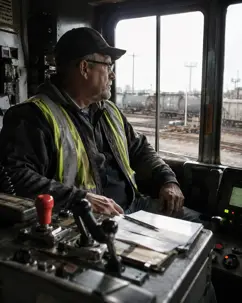
Job Title Alone Is Not Enough: Reconstructing a Railroad Worker's Actual Exposure
One of the biggest misconceptions about railroad cancer claims is that a person's job title tells the whole story. It doesn't. Two employees may have spent thirty years working as locomotive engineers, yet their exposure to diesel exhaust and other toxic substances could be dramatically different. That distinction can make all the difference when investigating a potential FELA claim.
Consider two engineers who hired on during the same decade and retired with similar careers. One spent most of his time operating newer locomotives on long-haul freight routes with improved ventilation and relatively modern equipment. The other worked older locomotives that frequently leaked diesel exhaust into the cab, switched cars in busy terminals, and regularly operated in yards where multiple locomotives idled nearby for hours. Although both retired with the same job title, their daily exposure to diesel exhaust may have been vastly different.
The same principle applies throughout the railroad industry. A machinist who rebuilt locomotive engines inside a diesel shop may have experienced very different exposures than a machinist assigned primarily to lighter maintenance work. A conductor working road freight may have encountered different conditions than one assigned to switching operations in a congested classification yard. The details of where a railroad employee worked, the equipment they used, and the conditions they encountered often matter far more than the title printed on a personnel file.
Modern FELA cancer cases increasingly focus on reconstructing that work history. Courts and medical experts look beyond a generic description of someone's occupation and instead examine the actual locomotives, rail yards, shops, terminals, maintenance practices, and chemicals that were part of the employee's everyday work. Employment records, locomotive assignments, co-worker testimony, historical railroad documents, and industrial hygiene evidence can all help recreate workplace conditions that existed decades before a cancer diagnosis.
This approach has become even more important as scientific research has evolved. Today, there is far more information about the health risks associated with diesel exhaust, asbestos, benzene, silica, and other workplace carcinogens than existed when many retired railroad workers were still on the job. The challenge is no longer simply identifying hazardous substances—it is determining whether a particular worker was likely exposed to them in sufficient circumstances to have contributed to the development of cancer.
That is why every railroad cancer case deserves an individual investigation. Two employees may share the same craft, seniority, and years of service, yet their exposure histories can be remarkably different. Understanding those differences often requires reconstructing an entire career, one assignment, locomotive, and work location at a time. When that investigation is done thoroughly, it can reveal a story that no job title ever could.
I think this article is particularly strong because it subtly educates prospective clients that your intake process is different. Rather than suggesting that every engineer or conductor has a claim, it explains why a detailed reconstruction of an individual's career is essential—a message that builds credibility with retired railroad workers while also distinguishing your firm from those that market broad, one-size-fits-all cancer claims.
Our firm approaches railroad cancer cases differently because we know that a successful claim begins long before a lawsuit is filed. From the initial intake and case evaluation, we work to reconstruct a client's entire railroad career, not simply collect employment dates or job titles. We take the time to understand the locomotives they operated, the shops and yards where they worked, the equipment they repaired, the products they handled, and the changing conditions they experienced over decades of railroad service. Our experience representing parties in complex occupational disease and toxic exposure litigation gives us a thorough understanding of where hazardous exposures occurred, how those exposures can be documented, and what evidence must be preserved before it is lost. That careful investigation allows us to identify not only diesel exhaust, but also other significant exposures—including asbestos, benzene, silica, solvents, welding fumes, creosote, and other workplace carcinogens—that may have contributed to the development of cancer.
Just as importantly, we understand how to transform that investigation into persuasive evidence. We work closely with qualified medical, scientific, and industrial hygiene experts to ensure they have the detailed occupational history and exposure evidence necessary to evaluate causation and support their opinions. Every case is developed with the expectation that it may ultimately be presented to a jury, while recognizing that the same thorough preparation often places our clients in the strongest possible position during settlement negotiations. Our objective is straightforward: to build a thoroughly investigated, scientifically supported case that accurately reflects our client's years of railroad service and presents the strongest possible foundation for achieving a favorable resolution, whether through settlement or at trial.